On June 24th 2016, people awoke to a country bitterly divided. You were either a Remainer or a Brexiteer, or even just someone who wanted to stick it to the establishment. Whichever way you voted you felt that the other side were either traitors or just deranged. Almost three years after the Brexit referendum the lines of division have not only been entrenched but new splits have arisen within the Remain and Leave camps with no end in sight.
The Brexit referendum did not primarily create these divisions but merely exposed them to the public consciousness. While revealing the divisions throughout society, the referendum also laid bare a bitterly divided House of Commons. From multiple votes on Mays deal, an indicative votes process and even no-confidence motions, the Commons has become gridlocked and the government incapable of moving forward.
As the Brexit crisis goes on, it continues to show how a minority government lacks the power required to deal with issues as complex and divisive as Brexit has become. As the results came in for the 2017 general election it was clear that May would lose her majority, forcing her to seek a confidence and supply arrangement with the Democratic Unionist Party. At first, it seemed like a good fit as both the Conservatives and the DUP wanted to press forward with delivering a form of Brexit. Then came the ‘backstop’.
The Irish backstop, a safety mechanism agreed between the UK and EU that prevents a hard border between the North and the Republic of Ireland, tore up the arrangement between the DUP and Mays government and created a fissure between groups of Conservative MPs. With the loss of support from the DUP and a significant number of her own MPs, Theresa May’s withdrawal agreement was set up for failure. On the 15th of January this year, May put her deal to the commons for the first time and was rejected by an astounding 230-vote margin, the largest government defeat in modern parliamentary history.
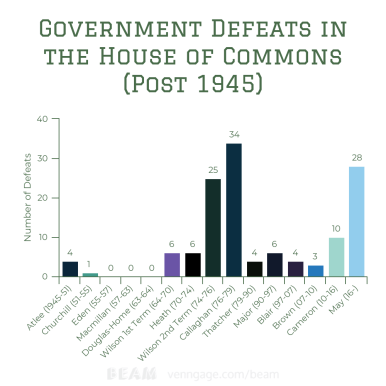 It is not unusual that in times of crises such as this, governments, particularly those with minority power, will be defeated on their own motions, partly due to dissatisfaction among MPs within the ruling party. The last time defeats such as this occurred on a regular basis was under the Callaghan government from 1976 to 1979. With a worsening economic situation and the Winter of Discontent bringing public services to a halt, the late 1970s proved to be a turbulent period for the Callaghan Labour government. Throughout his premiership, Callaghan would face 34 government defeats in the House of Commons, the highest of any post-war government to date. One such defeat would end his time as Prime Minister and lead to the rise of Margaret Thatcher.
“We must build a kind of United States of Europe. In this way only will hundreds of millions of toilers be able to regain the simple joys and hopes which make life worth living.” – Winston Churchill, September 1946
In 1946, a year after World War 2 had decimated vast areas of Europe, Winston Churchill called out for a radical new future relationship between European countries, in what he called a “United States of Europe”. Fast forward to the 1980s when Margret Thatcher, partly due to pressure from rising Euroscepticism among Conservative MPs, makes a pushback to European integration a key platform of her premiership. Since the days of the ‘Iron Lady’, Euroscepticism has flourished and deeply integrated itself within parts of the Conservative party’s mindset. In 2006, in his first conference speech as party leader, David Cameron proclaimed that the Conservative party should stop “banging on about Europe”, not knowing that the European issue would be his downfall and ultimately set the stage for the crisis the country faces at this very moment.
In the House of Commons today, Conservative MPs can generally be split into several factions regarding Brexit. The smallest group is that which supports the idea of a people’s vote. While minuscule in relation to the rest of the party, they have had quite a loud voice within the chamber thanks to Dominic Grieve who introduced and passed an amendment giving Parliament more say on parliamentary procedure related to Brexit. Apart from the unaffiliated, the rest of the factions want to see Brexit implemented by the government, they just can’t agree how. The largest group are those MPs who hold ministerial positions or are under the government payroll. These MPs will largely vote for the government’s motions and will stay loyal, with the exception of a few defections such as David Davis and Dominic Rabb who both resigned from the cabinet over their disagreements with the withdrawal agreement. Another faction that generally stays loyal to the government is the Brexit Delivery Group. The BDG is a mix of remain and leave voting conservative backbenchers that believe in the process of compromise and have tried to convince those not supportive of the government to switch sides.
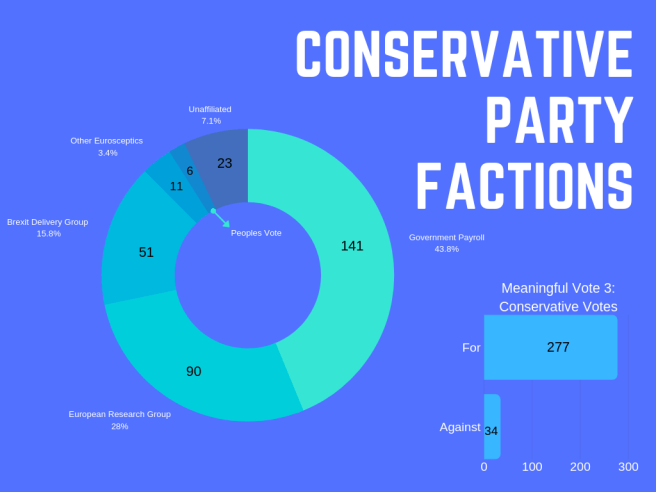
The second largest group, and arguably most influential, is the European Research Group. The ERG has made quite a name for itself throughout the Brexit process by making dramatic media appearances and calling on the Prime Minister to resign over her withdrawal agreement which their current chairman, Jacob Rees-Mogg, claimed was like “staying in the EU without a vote”. Since the beginning of the process, this group of backbenchers have been the thorn in May’s side and while some within the ERG have switched sides to support her deal in fear of losing Brexit altogether, they will continue to have significant power over the government’s policy.
The Labour party hasn’t escaped these divisions either and MPs across the party have settled into their own factions. In general, the Labour Party’s position on Brexit has been rather unclear since the referendum. Officially, the Labour leadership claim to support a new tariff-free customs union with the European Union and close ties to the single market. Unofficially, however, many within the party either support membership of the European Free Trade Association, commonly referred to as Common Market 2.0, or support the idea of a peoples vote.
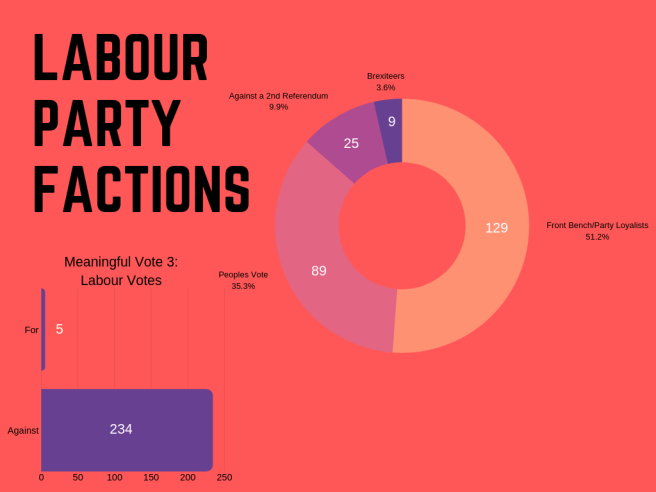
There are some Brexiteers within the party, such as Kate Hoey, but they have relatively no influence on party policy. A much more significant group are those MPs that come from strong leave voting areas such as Caroline Flint who have publicly pushed back against the idea of a peoples vote as they fear this would lead to the Labour party losing support in areas like their own.
While it may seem like a long time in politics, the Brexit deadline of October 31st is fast approaching. If MPs can’t pull themselves out of their trenches and find a solution, the rest of the country will be dragged along with them into the pits of division and squalor.
 Democratic Data