In the days and weeks leading up to June 23rd, 2016, prominent Brexiteers such as Nigel Farage proclaimed from their pedestals that the Brexit referendum would act as a trigger for the disintegration of the European Union itself. Country after country would hold similar referendums that would ultimately leave the EU a husk of its former self. The so-called ‘domino effect’.
“On June 23 Britain leaves the EU and changes Europe. We will trigger a domino effect. After us, other northern European countries will leave, starting with Denmark. The EU is about to collapse, disintegrating in several pieces.” Nigel Farage – June 11, 2016
In the end, however, this apocalyptic scenario did not happen. In fact, not only were these predictions wrong, they greatly underestimated how much of a positive effect the outcome of the referendum would have in increasing support for the European Union and its institutions throughout the continent. Since the referendum and all through the negotiations, this process has brought together the EU27 in a moment of cohesive unity that has not been seen in a long time.
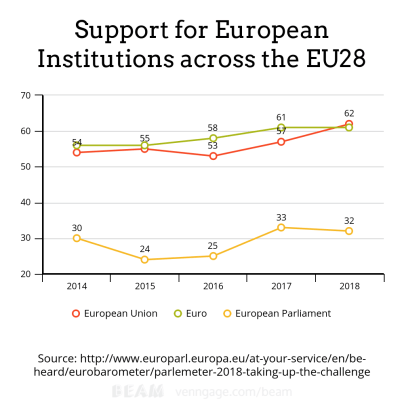
Every year, the European Parliament releases an annual report on public opinion across it’s member states, known as the Parlemeter. The most recent Parlemeter report was published in the autumn of last year and its findings showed a general increase in support for EU institutions across the board. In particular, the polling data for support of the European Union and European Parliament show a clear upswing during the aftermath of the referendum, with a rise from 53% to 62% and from 25% to 32% respectively. For institutions that were either losing public confidence or just flatlining pre-2016, it is hard to believe that the aftermath of the referendum had no effect on the changing attitudes across Europe.
It is important to note, however, that while reports such as these do show the situation for the EU is slowly improving, not all is perfect on the continent. Despite an improvement in recent years, support for the EU among southern European countries such as Italy and Greece is overshadowed by their distrust of EU institutions. In context, this low support starts to make sense. Greece is still recovering from the devastating and turbulent years of the Euro crisis and in Italy, populism is running riot after the recent election of the Lega Nord and 5 Star Movement coalition.
Last month at an emergency EU summit to discuss the UK’s article 50 extension, fractures began to appear among the EU27. Particularly Macron, who demanded that any extension granted should be no later than the 30th of June, an idea the vast majority of his colleagues opposed. In the end, they settled on a compromise. Nobody in the room that day got exactly what they wanted but they came to a pragmatic agreement that left most feeling that they had been listened to.
On June 24th 2016, people awoke to a country bitterly divided. You were either a Remainer or a Brexiteer, or even just someone who wanted to stick it to the establishment. Whichever way you voted you felt that the other side were either traitors or just deranged. Almost three years after the Brexit referendum the lines of division have not only been entrenched but new splits have arisen within the Remain and Leave camps with no end in sight.
The Brexit referendum did not primarily create these divisions but merely exposed them to the public consciousness. While revealing the divisions throughout society, the referendum also laid bare a bitterly divided House of Commons. From multiple votes on Mays deal, an indicative votes process and even no-confidence motions, the Commons has become gridlocked and the government incapable of moving forward.
As the Brexit crisis goes on, it continues to show how a minority government lacks the power required to deal with issues as complex and divisive as Brexit has become. As the results came in for the 2017 general election it was clear that May would lose her majority, forcing her to seek a confidence and supply arrangement with the Democratic Unionist Party. At first, it seemed like a good fit as both the Conservatives and the DUP wanted to press forward with delivering a form of Brexit. Then came the ‘backstop’.
The Irish backstop, a safety mechanism agreed between the UK and EU that prevents a hard border between the North and the Republic of Ireland, tore up the arrangement between the DUP and Mays government and created a fissure between groups of Conservative MPs. With the loss of support from the DUP and a significant number of her own MPs, Theresa May’s withdrawal agreement was set up for failure. On the 15th of January this year, May put her deal to the commons for the first time and was rejected by an astounding 230-vote margin, the largest government defeat in modern parliamentary history.
It is not unusual that in times of crises such as this, governments, particularly those with minority power, will be defeated on their own motions, partly due to dissatisfaction among MPs within the ruling party. The last time defeats such as this occurred on a regular basis was under the Callaghan government from 1976 to 1979. With a worsening economic situation and the Winter of Discontent bringing public services to a halt, the late 1970s proved to be a turbulent period for the Callaghan Labour government. Throughout his premiership, Callaghan would face 34 government defeats in the House of Commons, the highest of any post-war government to date. One such defeat would end his time as Prime Minister and lead to the rise of Margaret Thatcher.
“We must build a kind of United States of Europe. In this way only will hundreds of millions of toilers be able to regain the simple joys and hopes which make life worth living.” – Winston Churchill, September 1946
In 1946, a year after World War 2 had decimated vast areas of Europe, Winston Churchill called out for a radical new future relationship between European countries, in what he called a “United States of Europe”. Fast forward to the 1980s when Margret Thatcher, partly due to pressure from rising Euroscepticism among Conservative MPs, makes a pushback to European integration a key platform of her premiership. Since the days of the ‘Iron Lady’, Euroscepticism has flourished and deeply integrated itself within parts of the Conservative party’s mindset. In 2006, in his first conference speech as party leader, David Cameron proclaimed that the Conservative party should stop “banging on about Europe”, not knowing that the European issue would be his downfall and ultimately set the stage for the crisis the country faces at this very moment.
In the House of Commons today, Conservative MPs can generally be split into several factions regarding Brexit. The smallest group is that which supports the idea of a people’s vote. While minuscule in relation to the rest of the party, they have had quite a loud voice within the chamber thanks to Dominic Grieve who introduced and passed an amendment giving Parliament more say on parliamentary procedure related to Brexit. Apart from the unaffiliated, the rest of the factions want to see Brexit implemented by the government, they just can’t agree how. The largest group are those MPs who hold ministerial positions or are under the government payroll. These MPs will largely vote for the government’s motions and will stay loyal, with the exception of a few defections such as David Davis and Dominic Rabb who both resigned from the cabinet over their disagreements with the withdrawal agreement. Another faction that generally stays loyal to the government is the Brexit Delivery Group. The BDG is a mix of remain and leave voting conservative backbenchers that believe in the process of compromise and have tried to convince those not supportive of the government to switch sides.
The second largest group, and arguably most influential, is the European Research Group. The ERG has made quite a name for itself throughout the Brexit process by making dramatic media appearances and calling on the Prime Minister to resign over her withdrawal agreement which their current chairman, Jacob Rees-Mogg, claimed was like “staying in the EU without a vote”. Since the beginning of the process, this group of backbenchers have been the thorn in May’s side and while some within the ERG have switched sides to support her deal in fear of losing Brexit altogether, they will continue to have significant power over the government’s policy.
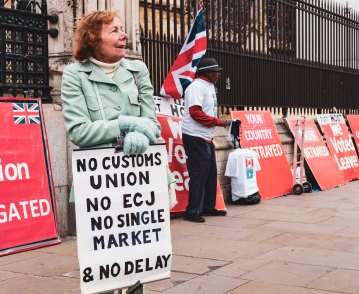
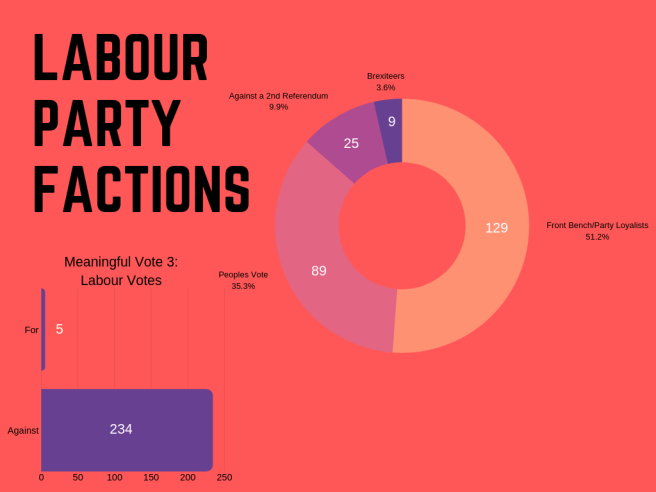
The Labour party hasn’t escaped these divisions either and MPs across the party have settled into their own factions. In general, the Labour Party’s position on Brexit has been rather unclear since the referendum. Officially, the Labour leadership claim to support a new tariff-free customs union with the European Union and close ties to the single market. Unofficially, however, many within the party either support membership of the European Free Trade Association, commonly referred to as Common Market 2.0, or support the idea of a peoples vote.
There are some Brexiteers within the party, such as Kate Hoey, but they have relatively no influence on party policy. A much more significant group are those MPs that come from strong leave voting areas such as Caroline Flint who have publicly pushed back against the idea of a peoples vote as they fear this would lead to the Labour party losing support in areas like their own.
While it may seem like a long time in politics, the Brexit deadline of October 31st is fast approaching. If MPs can’t pull themselves out of their trenches and find a solution, the rest of the country will be dragged along with them into the pits of division and squalor.
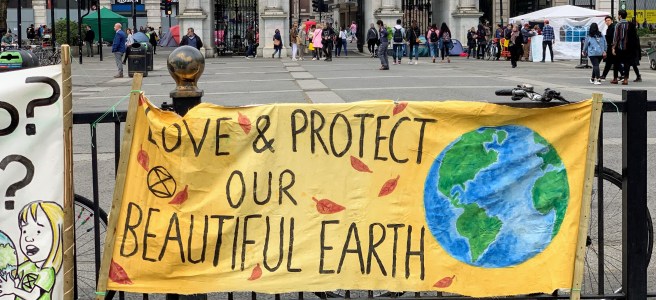
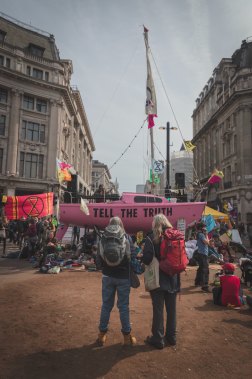
Over the past couple of weeks, thousands of demonstrators have taken to the streets across towns and cities throughout the UK. They call themselves Extinction Rebellion and claim that due to climate change, life on earth as we know it today will cease to exist unless governments act quickly. By causing disruptions to busy roads and staging “die-ins”, their cry out for action has been heard around the world.
It seems that the government has been listening to these protests as Environment Secretary Michael Gove came out to say that the activist’s “point had been made” while admitting that they had not done nearly enough to combat climate change.
So what is the government currently doing to tackle climate change and is it enough to curb what activists in Extinction Rebellion see as the single biggest threat to all life on earth?
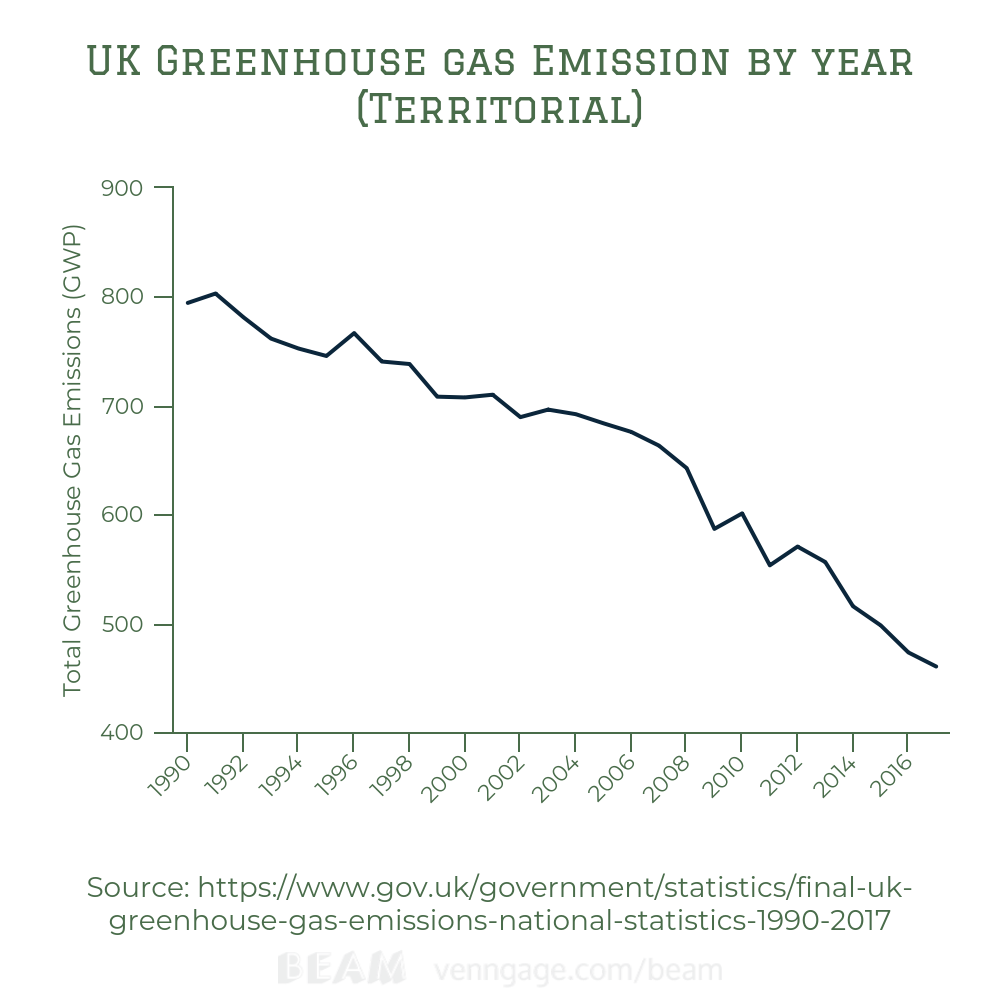
Earlier this year the government published its final estimates of the UK’s greenhouse gas emissions for the period covering 1990 to 2017. They show a clear downward trend in the UK’s emissions of not just carbon dioxide but other greenhouse gases such as methane and nitrous oxide by 42% since 1990. In the report, the Department for Business, Energy and Industrial Strategy found that one of the main reasons for this reduction in emissions was caused by the energy supply sector which saw its overall emissions cut down 7.6% from 2016 to 2017. They attribute this reduction to the sector’s push for more clean energy alternatives and a large decrease in the use of coal power stations.
What these figures do not show however are the UK’s non-territorial emissions (i.e., emissions that are not specifically produced in the UK but are consumed here). Non-territorial emissions include things such as air travel, international shipping, and imports. If the figures for non-territorial emissions were to be included alongside that of the territorial emissions found in the report, the reduction in overall emissions would fall from 42% to just 10%.
It is important to note however that non-territorial emissions are hard to pin on one single country due to long supply chains that run across borders. Figures on territorial emissions are useful as they show us what is being directly produced in the UK itself and show us specific sectors that need improving.
Currently enshrined in UK law, successive British governments must ensure that by 2050 carbon emissions fall to a net-zero, 25 years later than when Extinction Rebellion are demanding. At current rates, cutting emissions to net-zero by 2050 is going to be a challenge as the government is on track to miss their long-term targets if they do not act.
However, researchers at the Centre for Alternative Technology released a report in 2017 that suggested ways in which the UK could become a zero-emissions society by 2030. Some of the ideas suggested in the report include severely restricting air travel, a vast transformation of our energy sector with the construction of over 13,000 extra offshore wind turbines, and even collectively changing what we eat as a country. While these suggested changes are certainly possible, they will, however, require great will and determination by successive UK governments if they are to be achieved.
 Every year, the European Parliament releases an annual report on public opinion across it’s member states, known as the Parlemeter. The most recent Parlemeter report was published in the autumn of last year and its findings showed a general increase in support for EU institutions across the board. In particular, the polling data for support of the European Union and European Parliament show a clear upswing during the aftermath of the referendum, with a rise from 53% to 62% and from 25% to 32% respectively. For institutions that were either losing public confidence or just flatlining pre-2016, it is hard to believe that the aftermath of the referendum had no effect on the changing attitudes across Europe.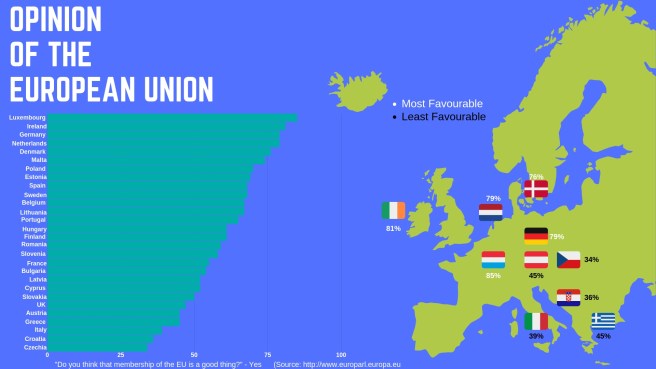
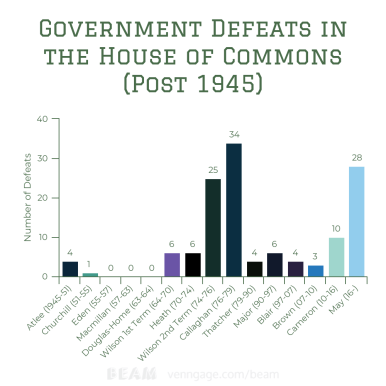 It is not unusual that in times of crises such as this, governments, particularly those with minority power, will be defeated on their own motions, partly due to dissatisfaction among MPs within the ruling party. The last time defeats such as this occurred on a regular basis was under the Callaghan government from 1976 to 1979. With a worsening economic situation and the Winter of Discontent bringing public services to a halt, the late 1970s proved to be a turbulent period for the Callaghan Labour government. Throughout his premiership, Callaghan would face 34 government defeats in the House of Commons, the highest of any post-war government to date. One such defeat would end his time as Prime Minister and lead to the rise of Margaret Thatcher.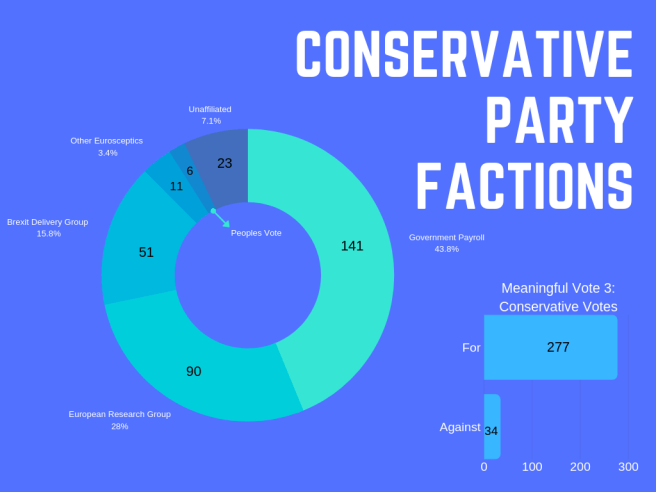
 Democratic Data