

In the days and weeks leading up to June 23rd, 2016, prominent Brexiteers such as Nigel Farage proclaimed from their pedestals that the Brexit referendum would act as a trigger for the disintegration of the European Union itself. Country after country would hold similar referendums that would ultimately leave the EU a husk of its former self. The so-called ‘domino effect’.
“On June 23 Britain leaves the EU and changes Europe. We will trigger a domino effect. After us, other northern European countries will leave, starting with Denmark. The EU is about to collapse, disintegrating in several pieces.” Nigel Farage – June 11, 2016
In the end, however, this apocalyptic scenario did not happen. In fact, not only were these predictions wrong, they greatly underestimated how much of a positive effect the outcome of the referendum would have in increasing support for the European Union and its institutions throughout the continent. Since the referendum and all through the negotiations, this process has brought together the EU27 in a moment of cohesive unity that has not been seen in a long time.
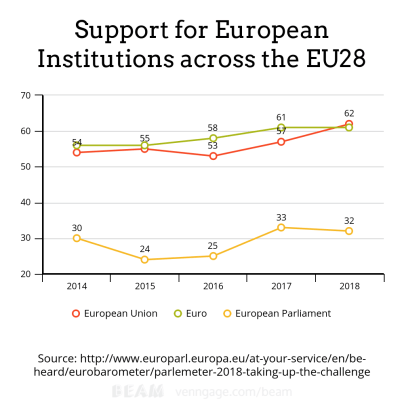 Every year, the European Parliament releases an annual report on public opinion across it’s member states, known as the Parlemeter. The most recent Parlemeter report was published in the autumn of last year and its findings showed a general increase in support for EU institutions across the board. In particular, the polling data for support of the European Union and European Parliament show a clear upswing during the aftermath of the referendum, with a rise from 53% to 62% and from 25% to 32% respectively. For institutions that were either losing public confidence or just flatlining pre-2016, it is hard to believe that the aftermath of the referendum had no effect on the changing attitudes across Europe.
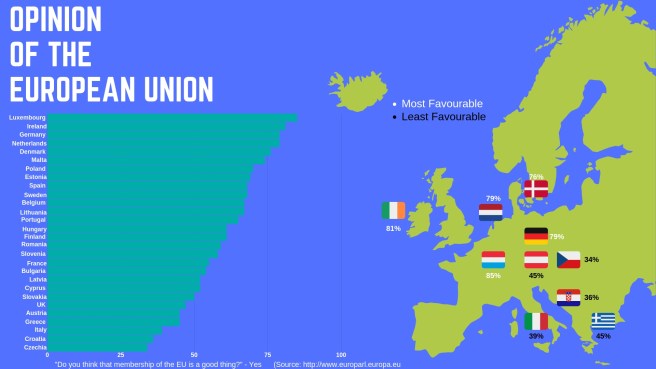
It is important to note, however, that while reports such as these do show the situation for the EU is slowly improving, not all is perfect on the continent. Despite an improvement in recent years, support for the EU among southern European countries such as Italy and Greece is overshadowed by their distrust of EU institutions. In context, this low support starts to make sense. Greece is still recovering from the devastating and turbulent years of the Euro crisis and in Italy, populism is running riot after the recent election of the Lega Nord and 5 Star Movement coalition.
Last month at an emergency EU summit to discuss the UK’s article 50 extension, fractures began to appear among the EU27. Particularly Macron, who demanded that any extension granted should be no later than the 30th of June, an idea the vast majority of his colleagues opposed. In the end, they settled on a compromise. Nobody in the room that day got exactly what they wanted but they came to a pragmatic agreement that left most feeling that they had been listened to.

 Democratic Data